

HOW IT WORKS
The Endocannabinoid System and Hemp Extract
Almost everyone has heard the intriguing chatter, exciting possibilities, potential and promising effects of full-spectrum CBD. But do you know the how and the why CBD works? These two questions open the door to a vast and complex system known as the Endocannabinoid System (ECS). Discovered in 1992 by NIMH researchers Raphael Mechoulam, William Devane and Dr. Lumir Hanus the science behind the ECS is still just in its infancy. Thanks to the passing of the farm bill in 2018, giving way for US research, knowledge and understanding have begun to explode. Receptors for the ECS have been found across species in humans & animals, birds, fish, sea urchins, and reptiles. At present, there are two known types of cannabinoid receptors, CB1 and CB2, with mounting evidence of undoubtedly more. What is currently known, is that the human brain contains more cannabinoid receptors than any other G protein-coupled receptor type. G Protein receptors detect molecules outside of cells and activate cellular response.
The 3 Fundamental Basics of the Endocannabinoid System
Endocannabinoids (eCBs)
Endocannabinoids (eCBs) are the liaisons or messengers for the ECS and are naturally occurring throughout our bodies. The two major eCBs neurotransmitters circulating within our bodies are anandamide and 2-arachidonoylglycerol. Like phytocannabinoids in cannabis, these neurotransmitters are built from lipids, also known as fats or oils.
Anandamide- Discovered in the 1990's, anandamide, occurring in both the central and peripheral nervous system, works throughout the endocannabinoid system and is linked to playing a role in human behavior, appetite, memory, pregnancy, sleep patterns, pain relief and more. It has also been associated with the origin of the "runner's high" the feeling of euphoria coupled with reduced anxiety and a lessened ability to feel pain.
2-Arachidonoylglycerol (2-AG)- The second endocannabinoid to be discovered was anandamide's sister, 2-arachidonoylglycerol. With high levels located in the central nervous system, 2-arachidonoylglycerol is found in extraordinarily high concentrations in the brain, approximately 170 to 1000 times higher than that of anandamide. Acting usually as a full agonist (initiating a physiological response) to both CB1 and the CB2 receptors, it is believed to be the messenger molecule, regulating signals across the brain, food intake and energy absorption.
Cannabinoid receptors (CB receptors)
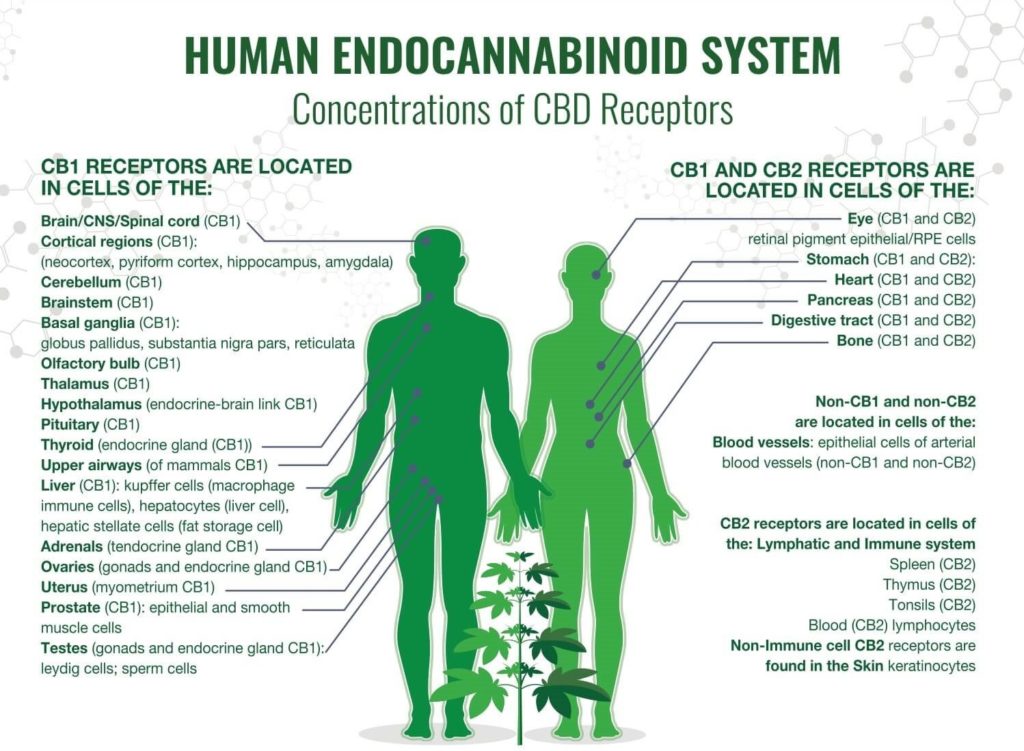
Cannabinoid receptors sit on cell surfaces waiting for specific neurotransmitters to pass by to bind to them. Depending on the type of cell the CB receptor is planted on, the effect, once bound, will promptly influence immunity, sensation, mood and consciousness. To date, only two types of cannabinoid receptors have been identified, CB1 and CB2. Although some cannabinoids can interact with both, CB1 and CB2 receptors only share 48% amino acid sequence identity. They are distributed in different tissues, have different signaling mechanisms and differ in their sensitivity to agonists (initiating a physiological response) and antagonists (interfere with or inhibit physiological response).
CB1- The CB1 receptor is expressed in both the peripheral nervous system and central nervous system (highest density). They are found on nerve cells in the brain, spinal cord, in some peripheral organs and tissues such as the spleen, white blood cells, endocrine gland and parts of the reproductive, gastrointestinal and urinary tracts and play a role in pregnancy, hormone production, cardiovascular health and digestion. As sited in the Science Direct, Journals and Books, "Their distribution corresponds to the behavioral effects of Cannabis—pleasure, anxiety, fear, panic, learning and memory, thinking, concentration, movement, coordination, increased appetite, and sensory and time perception." Found in significant numbers in the cerebellum, basal ganglia, hippocampus and dorsal primary afferent spinal cord regions of the brain, cannabinoids regulate behavior within the body such as memory processing, motor control, and pain regulation, while a relatively low number of cannabinoids are found in the brain stem, suggesting why cannabis use is not associated with sudden death due to depressed respiration.
CB2- The CB2 receptor are most abundant and most often found on the cells of our immune system. They assist in the moderation of inflammation and our immune response to pathogens. Found predominately on white blood cells, tonsils and the spleen, CB2 receptors play an important role in the regulation of cytokine release. Cytokines, also molecular messengers, are proteins produced by cells that regulate various inflammation responses in regards to arthritis. They interact with cells of the immune system in order to balance the body's response to disease and infection while regulating normal cellular processes in the body.
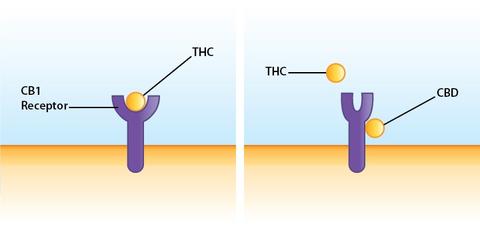
Although most cannabinoids (endocannabinoids, anandamide, 2-Arachidonoylglycerol (2-AG) and phytocannabinoids like THC) are able to bind to both CB1 and CB2 receptors, phytocannabinoid CBD, plant derived, doesn't directly activate the receptors but, instead modifies their ability to bind to the cannabinoids.
Restoring and Supporting a Healthy ECS
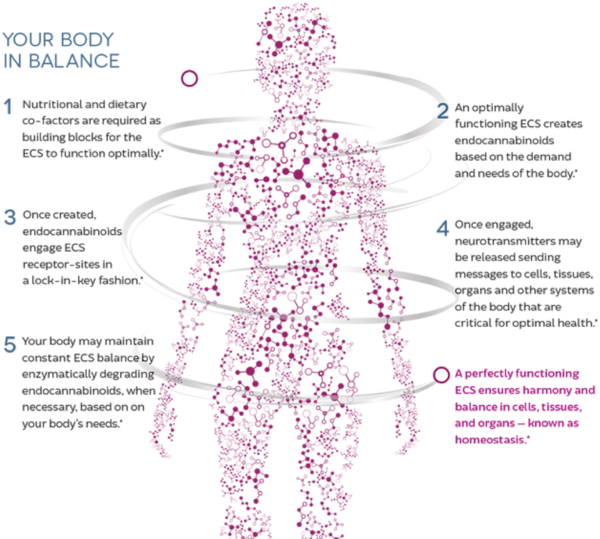
Unfortunately, even the influential and all-powerful endocannabinoid system can be very easily thrown out of sync. Three major factors contributing to the overall "balance" or "imbalance" of the ECS are stress, diet and exercise. Increasing your dietary intake of the omega-3s, found in hemp oil, may also help boost your body's natural production of eCBs.
Is something off or out of sync with your endocannabinoid system? Wanting to rebalance with a more holistic approach?
Let realign introduce you to a way to restore and support this intricate system the way Mother Nature intended.
Realign…Back to Basics, Back to Nature.
“It’s easy to get a thousand prescriptions but hard to get one single remedy”
-Chinese Proverb
Terpenes and the Entourage effect
We, at realign, are strong believers in whole plant extract. We believe in keeping the plant as whole as possible to ensure the greatest entourage effect. We presume this is the way Mother Nature intended her plant to restore and support not only across species but our planet as well. This presumption is also why our products are centered and developed around whole plant extract. Our food-grade alcohol extraction protects and maintains higher levels of both terpenes and chlorophyll, essential components of the Cannabis plant.
Terpenes
Terpenes are the aromatic oils found throughout nature that furnish each plant with its distinctive taste and smell characteristics. While its main attraction for most people is associated with sensory, terpenes also play an essential role in modulating the medical attributes of Cannabis. Similar to cannabinoids, terpenes bind with certain receptors and neurotransmitters producing an impressive lineup of effects while facilitating the ability of cannabinoids to pass through the blood stream easier. Some terpenes are responsible for enhancing mood while others boost energy. Terpenes also play a critical role in protecting the Cannabis plant itself from predators or other plants attempting to invade their territory. This “chemical warfare” is vital due to the plants inability to move, flee or escape potential dangers. These terpenes may perform the same way in realign’s products by aiding and protecting from unwanted bugs and insects.
Ingested or topically applied alongside cannabinoids, terpenes interact with the endocannabinoid system to expedite the absorption and effects of cannabinoids. Extremely rich in terpenes, the Cannabis plant is known to have over one hundred distinctive types. Among those, there are eleven that are most commonly found in the Cannabis plant.
Below is a list of those eleven, including other plants known to carry
the same terpenes.
Synthetically created CBD products do not carry these terpene compounds, thus lacking the benefit of whole plant extraction and diminishing the effectiveness of CBD molecules.
The Entourage Effect
What has been coined as the “Entourage Effect” is a term describing the results or effects produced from the synergistic (harmonious) interaction of cannabinoids, terpenes, flavonoids and fatty acids naturally found in the Cannabis plant. Dr. Ethan Russo, a board-certified neurologist, psychopharmacology researcher, and former Senior Medical Advisor to GW Pharmaceuticals has been instrumental in the research and understanding of the entourage effect in Cannabis.
In his study “Taming THC: potential cannabis synergy and phytocannabinoid-terpenoid entourage effects” he details the influence and importance that the Cannabis compounds have on each other’s mechanisms. This influence is at its greatest power when all of the plant compounds are kept together. The outcome of this effect is an essential part of alternative medicine and is why, when using the entire plant, its power is increased to an exponentially higher level rather than the isolation or production of an active ingredient(s) in a laboratory setting.